The Pixelated Power of Mono Blocky Bitmap Letter H
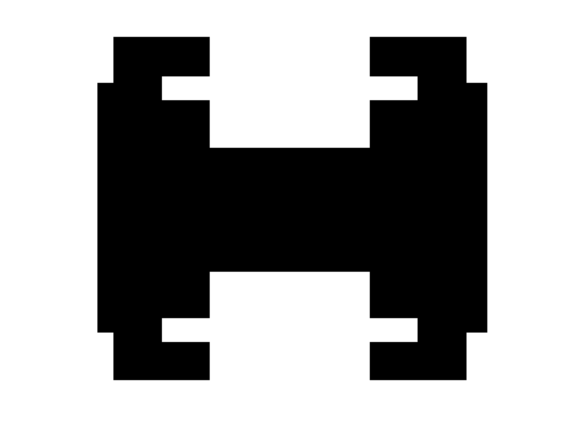
In a digital world saturated with sleek vector curves and fluid animations, a return to the fundamentals of form can be arresting. The Mono Blocky Bitmap Letter H stands as a deliberate testament to this principle. This glyph, crafted from a singular, unyielding block of pixels, is more than a character; it is a design object, a stylistic anchor, and a ready-made emblem of retro aesthetics. Its very construction—a monolithic pixel-inspired shape—invokes the early days of computer graphics, arcade cabinets, and the charming constraints of low-resolution displays. The letter H, in this particular incarnation, becomes a bridge between pure typography and tangible craft.
Decoding the Design: Characteristics of a Pixel Perfect Letter
Understanding the Mono Blocky Bitmap Letter H requires an appreciation of its core characteristics. Unlike scalable vector letters built from paths, this is a bitmap-inspired design rendered in SVG. This means its essence is blockiness. Each edge is sharp, each corner is defined at a right angle, and the form is built from the conceptual idea of a single, filled pixel block expanded into a legible shape. There is no subtlety in its serifs, no variation in its stroke weight. Its strength lies in its absolute uniformity and geometric clarity.
This design choice results in a letter with immense visual weight. It sits heavily on the baseline, commanding space. The negative space within its central opening—the counter—is as blocky and deliberate as the letter itself, creating a perfect, symmetrical void. The color is typically uniform, a solid fill, though the SVG format allows this to be changed effortlessly. The overall impression is one of stability, simplicity, and digital nostalgia. It is a letter stripped back to its most primitive graphical components, yet achieving a powerful, modern iconic status.
Why SVG Format Matters for Creators
The provision of this letter as a single SVG file is a critical detail. SVG, or Scalable Vector Graphics, is a web-friendly vector format. For the artist, designer, or crafter, this means the Mono Blocky Bitmap Letter H is infinitely scalable without loss of quality. You can enlarge it to fill a poster or shrink it for a jewelry engraving, and its crisp, blocky edges will remain perfectly sharp. Furthermore, SVG files are typically editable in common design software like Adobe Illustrator, Inkscape, or Affinity Designer. The color can be altered, the element can be duplicated, rotated, or integrated into larger compositions without compromising the original design integrity.
The Broad Spectrum of Practical Applications
The utility of such a specific design element is surprisingly vast. Its clarity and strong thematic cue make it adaptable across numerous mediums and purposes.
- Custom Apparel & Merchandise: The Mono Blocky Bitmap Letter H is a prime candidate for heat transfers, screen printing, or embroidery on t-shirts, hoodies, and caps. Its bold form ensures readability and visual impact. It can serve as a central logo for a brand, a team initial, or a statement piece for gaming-themed clothing.
- Home Decor & Personal Accessories: Applied to mugs, posters, laser-cut acrylic wall art, or even etched onto wooden plaques, the letter brings a defined, tech-retro vibe to any space. Its simplicity aligns well with minimalist decor that seeks a single point of pixel-art interest.
- Digital Design & Branding: Web designers can incorporate the SVG directly into site headers, icons, or branding elements for projects related to gaming, tech history, or abstract art. Its load time is minimal, and it can be animated or interacted with using CSS or JavaScript.
- Crafting & DIY Projects: For crafters using vinyl cutters (like Cricut or Silhouette), the SVG file is ready to be used for creating stickers, decals, or layered paper art. The single, solid shape is ideal for clean cutting and application.
These applications are not limited to the letter H as an alphabetic entity. It can be treated as a symbol, a building block in a larger pixel-art mosaic, or repeated to form patterns and borders. Its very blockiness makes it a perfect modular unit for more complex, custom creations.
Standing Out: The Advantage of Defined Nostalgia
In a marketplace where personalization is key, using a design with a clear, pre-defined aesthetic like the Mono Blocky Bitmap Letter H offers distinct advantages. It provides immediate thematic cohesion. A product decorated with this letter carries a recognizable retro-gaming connotation without requiring elaborate explanatory design. This shorthand communication is valuable for creators targeting specific communities or sensibilities.
Furthermore, its strength is its lack of ornamentation. In an age of overly complex logos, this letter’s brutal simplicity is a visual palate cleanser. It stands out precisely because it does not try to compete with detail; it competes with presence. For small businesses or individuals looking for a memorable initial or symbol, it offers a ready-made, professional-looking graphic that avoids the clichés of more common font-based logos.
Considerations for Effective Use
While versatile, the Mono Blocky Bitmap Letter H is not universally appropriate. Its successful deployment depends on contextual awareness. It may clash with overly elegant or organic design schemes. The key is to either embrace the contrast deliberately or to build a consistent environment around it. Using complementary pixel-art elements, a constrained color palette reminiscent of early computer graphics, or typefaces that share its geometric rigidity can create harmonious projects.
Another consideration is legibility at extreme scales. While the SVG ensures technical scalability, the very blocky form might become overly abstract if made too small, losing its immediate recognition as the letter H. Testing the size in context is always recommended. Finally, while the single file is provided, understanding how to manipulate it in design software unlocks its full potential. Learning basic SVG editing skills allows one to change colors, combine letters, or integrate it into custom layouts.
From File to Physical Object: A Creator's Workflow
Imagine a scenario: a hobbyist wants to create a custom t-shirt featuring their initials with a retro game aesthetic. They acquire the Mono Blocky Bitmap Letter H SVG file for their initial. Their workflow might proceed as follows. First, they open the file in a vector editing program. They duplicate the letter to create a pair, or perhaps combine it with another blocky letter from a similar set. They adjust the colors to match their desired shirt color—perhaps opting for a classic neon green on black.
After arranging the composition, they export the design in a format suitable for their chosen production method. For screen printing, they might provide a high-resolution PNG. For a vinyl cutter, they keep the SVG format and import it directly into the cutter's software, where they can mirror the design and set cut lines. The physical act of crafting then takes place—weeding the vinyl, applying the transfer, or preparing the screen. The final result is a product where the digital authenticity of the pixel-inspired design is materially manifested.
This workflow highlights the seamless journey from digital asset to physical artifact. The SVG file acts as the perfect intermediary, preserving the design's intent across both realms.
The Letter as a Cultural Touchpoint
Observing the use of such elements reveals a broader trend. The Mono Blocky Bitmap Letter H taps into a collective nostalgia for 8-bit and 16-bit eras. It is not merely a style; it is a reference. For educators, it can be a tool in discussing the history of digital typography and graphical limitations. For researchers, it might represent a case study in the persistence of early digital aesthetics in contemporary culture. For businesses, it can be a deliberate branding choice to align with innovation, fun, or a tech-savvy audience.
Its existence as a standalone SVG letter also reflects the democratization of design. High-quality, thematically specific graphic resources are now accessible to non-professionals, enabling a wider range of people to produce visually coherent and appealing work. This letter, in its straightforward blocky glory, is both a product and a symbol of that accessibility.
In essence, the Mono Blocky Bitmap Letter H is a versatile, potent design primitive. It serves as a building block for personal expression, a nod to digital heritage, and a functional file ready for transformation across countless surfaces and screens. Its value lies in its deliberate simplicity and the vast creative potential that simplicity unlocks for anyone willing to see a single letter not just as text, but as a craft-ready icon.