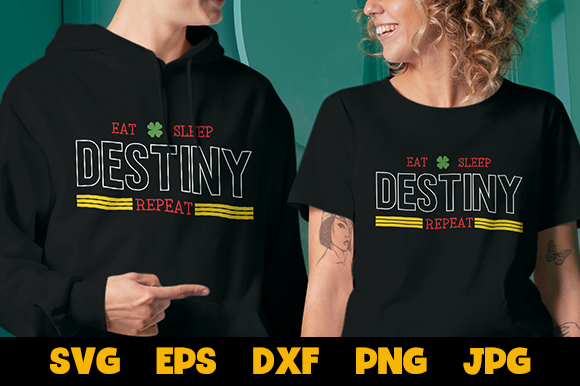
Integrating the Eat Sleep Destiny Repeat Design into a Creative Production Workflow
For creators, entrepreneurs, and professionals working in merchandising or personal branding, a high-quality digital asset like the Eat Sleep Destiny Repeat SVG and EPS10 pack is more than just a graphic; it's a foundational component in a production pipeline. This instant download package, containing vector formats (SVG, EPS10, DXF) and high-resolution raster files (PNG, JPG at 300 dpi), is designed for direct integration into a practical workflow. Its utility lies not in a single use, but in its flexibility across the entire process from conceptualization to final product.
The Asset as a Process Enabler
The phrase "Eat Sleep Destiny Repeat" resonates within gaming communities and beyond, often symbolizing dedication and passion. When this sentiment is captured in a professionally designed graphic file pack, its value shifts from conceptual to operational. The core of this asset is its multi-format delivery, which directly addresses a common hurdle in creative production: compatibility. By providing the same design in SVG for web and scalable print, EPS10 for professional vector editing, DXF for certain cutting machines, and high-quality PNG/JPG for straightforward applications, this pack eliminates the need for format conversion—a step that often compromises quality or wastes time.
This pre-solved compatibility issue fits neatly into the initial preparation phase of any project. Before committing to a design for a T-shirt line, a series of mugs, or promotional stickers, a creator can evaluate this asset across all intended software and hardware. Testing the SVG in a web design mockup, opening the EPS10 in Adobe Illustrator to check layer structure, and verifying the DXF with a CNC or vinyl cutter software ensures the asset is viable for the entire project scope. This preparatory vetting prevents mid-project stalls and guarantees a smooth transition into the active production phase.
Workflow Integration and Practical Applications
Consider a small business owner launching a niche gaming merchandise store. The workflow begins with branding and product selection. The Eat Sleep Destiny Repeat design, acquired as an instant download, enters this workflow at the asset acquisition stage. Since no physical items are sent, integration is immediate. The ZIP file is unpacked, and the relevant files are organized into the business's digital asset library—perhaps sorted by project type (e.g., "Apparel," "Drinkware," "Decals"). This organizational step is crucial for long-term use and efficiency, allowing the same asset to be reused across multiple product cycles.
During the Production Phase
During active production, the different file formats interact with specialized tools and platforms. For print-on-demand services, which often have specific file requirements, the high-resolution 300 dpi PNG or JPG might be uploaded directly to the platform's interface for a mug or poster. For a hands-on creator using a vinyl cutter to make stickers or signs, the DXF file becomes the primary resource, ensuring clean cut paths. Meanwhile, a graphic designer tasked with creating a composite banner for a gaming event might import the SVG file into a larger Adobe Illustrator composition, leveraging its scalability and editable paths without quality loss. This simultaneous, format-specific use underscores the pack's role in parallel processes.
The vector files (SVG and EPS10) offer particular advantages for consistency and quality control. If a design needs minor tweaks—adjusting a color for a specific fabric or isolating an element for a logo—the EPS10 file allows for precise editing in professional software. This maintains design integrity across variations. The scalability ensures that whether the graphic is printed on a small sticker or a large wall sign, the output remains sharp, which is a fundamental quality control checkpoint.
Strategic Implementation Across Different Scenarios
The utility of this asset extends beyond commercial merchandise. A blogger or content creator focused on gaming might use the high-quality PNG as a recurring visual motif in video overlays or website graphics, enhancing brand consistency. An educator running a game design workshop could incorporate the files into a practical lesson on digital asset preparation for physical products, demonstrating the real-world link between design files and manufacturing. In each scenario, the workflow differs, but the integration point remains: the asset serves as a ready-to-use, high-fidelity component that requires no further sourcing or adaptation.
For the productivity-minded user, the "instant download" model itself is a workflow optimization. It bypasses the lead time and logistical friction of physical shipments, aligning with digital, fast-paced project timelines. The decision to purchase such a pack often comes after a resource audit, identifying the need for a versatile, ready-made design to accelerate a project's go-to-market timeline or to fulfill a specific client request without starting from scratch.
Long-Term Asset Management and Reuse
A key observation for sustainable workflow integration is the long-term management of such files. After the initial project—say, a successful T-shirt run—the asset pack should be archived alongside project documentation. This practice enables future efficiency. When a new idea emerges, like expanding the product line to include laptop skins, the creator can return to the already-vetted, multi-format files, saving the preparation and compatibility testing phase entirely. This turns the initial integration effort into a recurring time-saving advantage.
Usability is also enhanced by the file's common formats. Most design software and online platforms support SVG and PNG, while EPS is a standard in professional print environments. This widespread acceptance reduces the learning curve or need for specialized tools, making the asset accessible to hobbyists using free software and professionals on paid suites alike. The outcome is a democratization of production capability, where the quality of the final printed item—on anything from a mug to a sign—is not constrained by the user's technical expertise in file conversion.
Conclusion: A Component, Not a Product
Ultimately, the Eat Sleep Destiny Repeat SVG, EPS10 and accompanying files should be viewed as a high-quality component within a broader system. Its value is realized through its seamless insertion into planning, execution, and iteration cycles. By solving the format problem at the source and delivering industry-standard files, it allows the user to focus on the creative, commercial, or communicative goals of their project, rather than on technical asset preparation. For anyone operating in a workflow that bridges digital design and physical output, such a resource is not merely a graphic; it's a streamlined step in the process, enabling focus to remain on the larger destiny of the project itself.